
Chanel was my first real job. I worked my way up and eventually found myself in rooms I was not expecting to be in, being told things about how the brand operated that most people selling it never heard.
I loved the brand then and I love it now. From a branding perspective, Chanel is one of the most sophisticated seductions in the history of commerce. Not a brand. A seduction. One that has been running continuously for over a hundred years without ever breaking character.
Understanding how it works might be the most valuable thing you ever learn about building something people actually want.
She Started With a Bottle and a Dinner Party
Coco Chanel did not launch Chanel No. 5 with a campaign. She invited wealthy women to dinner and gave them bottles of perfume. She sprayed it throughout her boutiques so that every person who walked through the door inhaled the scent before they saw a single product. She seduced them into the desire before they knew they had it.
This was not marketing. This was psychological precision dressed as hospitality.
She understood something that most brand builders never figure out. You do not create desire by explaining your product. You create desire by making people feel something they cannot name and then handing them the object that seems to answer it. The conscious mind never gets involved. By the time it shows up the decision has already been made.
The Scarcity Was Never an Accident
When Chanel No. 5 became too widely available in the 1960s something dangerous happened. It became common. The perfume that Marilyn Monroe wore to bed was now everywhere, and everywhere is the enemy of desire.
So they did something that went against every instinct in business. When the perfume was underperforming in 1974, the CEO pulled it from 6,000 stores in the United States. Made it harder to find. Manufactured the scarcity deliberately.
Robert Greene writes in The Art of Seduction that satisfying desire ends the seduction. So you never fully satisfy it. You keep the wanting alive.
To this day Chanel has no discounts, no flash sales, no markdowns. The price never drops because dropping the price would break the spell. It would tell the customer that the object is just an object.
And the object was never the point.
What They Showed Us in the Briefings
The number 5 is woven into everything. The visual language, the timing, the mythology. Coco's lucky number embedded into everything she built the way a composer hides a motif inside a symphony.
But the number 5 was just the beginning.
In the briefings I sat in on, we were shown how the ads worked beneath the surface. Hidden within the imagery, inside the reflections of pearls, in the depth of eyes, in the shadows of photographs, were images designed to trigger something the conscious mind would never register. Desire. Aspiration. The vague but persistent feeling of wanting something you cannot quite name.
The ads were not selling perfume. They were embedding an instruction.
Look at the Chance bottle. Shaped like an engagement ring. Fronted by young luminous faces full of possibility and promise. That is not a fragrance launch. That is a proposal. Chanel has always understood that what it is really selling is youth, desire, and the fantasy of being chosen. The elegance is the wrapper. Underneath the brand has always been slightly transgressive and completely deliberate about it.
By the time a customer walked through the door they had already surrendered. They just did not know when it happened.
What Is Actually in the Jar
In the early 2000s Chanel launched the Sublimage Crème Régénérante Fondamentale. The origin story was extraordinary. Research begun in 1995. A proprietary ingredient discovered in Madagascar. Farmers hand-pollinating each flower during a 24-hour bloom window using techniques passed down through generations.
The star ingredient was Vanilla Planifolia.
Which is vanilla.
The science is genuine. Chanel researchers did isolate specific molecules in the vanilla plant with real regenerative properties. But the jar retails for $505 for 1.7 ounces. And alongside the ingredient sits the same synthetic chemicals and fragrance compounds found in products sold at a fraction of the price.
The distance between what is in the jar and what you are paying for is filled almost entirely by the seduction.
This is not unique to the skincare. Chanel's fabrics and materials across their ready-to-wear lines have quietly declined in quality over the years. The construction is not what it once was. Industry insiders know it. But the pieces still look extraordinary. The cut is still right. The logo is still there. And at those prices, the exclusivity itself becomes the quality. If everyone cannot have it, the ones who can will convince themselves it is perfect.
That is not a flaw in the strategy. That is the strategy.
What This Means for Anyone Building Something
Most businesses compete on product. Better ingredients. Faster delivery. More features. Lower price. And they wonder why none of it moves people the way they hoped.
Chanel never competed on product. Chanel competed on desire. And desire lives in a completely different part of the brain than logic, value comparison, or feature lists.
The lesson is not to cut corners and hide it behind a logo. The lesson is to understand what you are actually selling. You are never just selling a thing. You are selling a feeling, an identity, a version of someone's life they want to inhabit. The product is the vessel. The desire is the product.
Build something people want to be seen with. Make them feel chosen for finding it. Never fully satisfy the wanting. And never, under any circumstances, put it on sale.
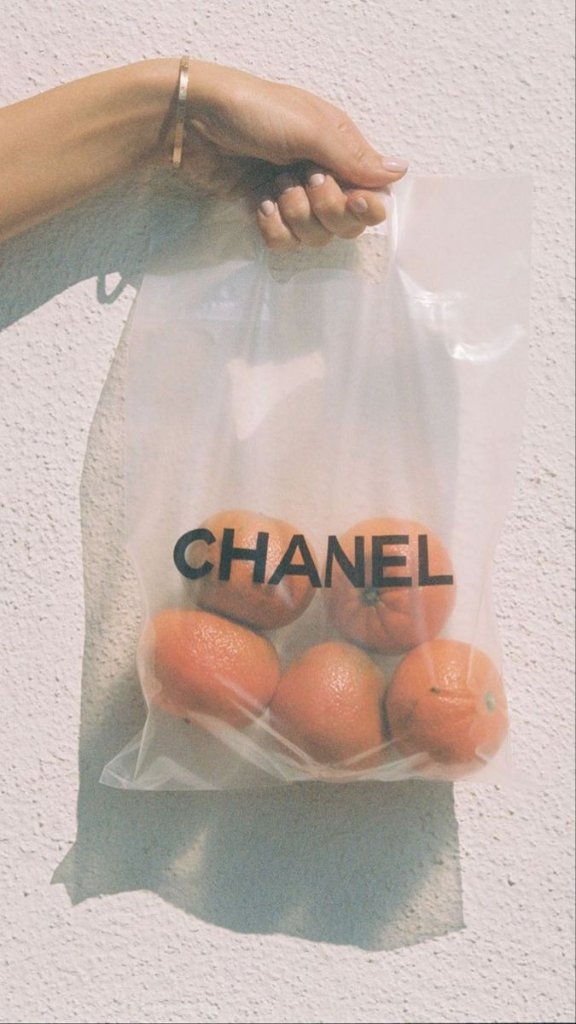
This bag of oranges is the proof. A logo so powerful it transforms ordinary fruit into something you want to be seen holding. The logo does not describe what is inside. It seduces it.
Coco would agree. She also would have charged you $500 for the advice.